
Welcome to Jankrish
A linguistic design project that explores what happens when English words, Sanskrit inflections, and Japanese flow go on a retreat together to eliminate rigid sentence rules.

I have a confession: I’ve been using my free time lately to play around with a little linguistic hobby project.
The story of how this happened is completely accidental. A while ago, I spent an entire month trying to learn the Japanese Hiragana script. It was a fun challenge, but it was also mentally exhausting. My brain was feeling the heavy cognitive load, and I desperately needed an organic “cognitive win”—something satisfying to prove I was actually getting somewhere with the language.
So, I stepped back from the alphabet grind. Suddenly, a shortcut clicked that enabled me to grasp the core of Japanese grammar in less than two hours. When I looked at how Japanese uses tiny tracking tags to guide sentences, my brain immediately treated it like a clean design system.
With a background in computer science, my day job involves dealing with standards that allow multiple disparate systems to talk to each other, so the dots instantly connected. It felt as if English, Sanskrit, and Japanese went on a retreat, giving rise to Janskrish. I started drawing architectural lines between the familiar roots of English words, the deep mathematical inflections of Sanskrit, and this newfound Japanese flow.
That sudden spark is how Janskrish was born. It is a creative outlet, a fully functional constructed language built from scratch, with exactly one defining superpower: absolute free word order.
We have been conditioned to think in a straight line. Every second of our lives, when we speak English, our brains are trapped inside a rigid, unyielding cage called Subject-Verb-Object (SVO) syntax. If we want to say that a dog stole a bone, we are forced to deploy those words in a strict, linear queue: The dog stole the bone. If we get excited, if we panic, or if our brain flashes the image of the bone first and we shout, “Bone dog stole!”—the logic shatters. The system glitches. We sound like a broken machine. English forces our fluid, chaotic human consciousness to wait in line, demanding that we organize our thoughts chronologically before letting them leave our mouths.
Janskrish breaks that linear cage. It is a linguistic design experiment utilising a modular, packet-based paradigm to map unstructured English roots into synthetic Sanskrit inflections and invariant Japanese syntactic tokens.
In this system, every word operates like a self-contained data block. You can scramble the sequence of a sentence entirely, and a listener can still re-assemble it perfectly without losing a single shred of meaning—rendering word order completely irrelevant.
How the Little Engine Works
In Janskrish, syntax constraints do not exist. You can take a 10-word sentence, throw the words into a blender, pour them out in a completely backward, chaotic sequence, and the statement remains 100% stable, grammatically flawless, and instantly intelligible to a listener.
To pull this off without forcing you to memorise thousands of annoying new vocabulary words, Janskrish treats language like software architecture. Every single word operates as a self-contained “smart capsule”that carries its own hardcoded metadata tags.
We build this engine by fusing the strengths of three entirely different linguistic titans:
English provides the Core Asset: It supplies 100% of the raw vocabulary roots (dog, eat, building, happy). You don’t have to learn a single new word. But we strip English entirely of its rigid word-order rules, its lazy plurals, and its clumsy verb endings.
Sanskrit provides the Internal Math: Pure Sanskrit natively possesses free word order because it uses deep inflections. Janskrish steals this precision to bake structural numbers—including the hyper-precise dual form for exact pairs—directly into the flesh of the word. Furthermore, Sanskrit’s legendary Dhatu system allows us to mathematically manufacture entire ecosystems of nouns and locations straight out of basic English action roots (
√COOKautomatically generates Cooktr [Chef] and Cookasthal [Kitchen]), entirely eliminating the need to borrow external words.Japanese provides the Traffic Control: Pure Sanskrit is beautiful but exhausting—it demands that you memorise thousands of mutating spelling charts based on word endings. Janskrish cheats the system using Japanese. Japanese particles (ga, o, ni) act like invariant Post-It notes. By gluing them onto the tail-end of our Sanskrit suffixes, we flatten Sanskrit’s endless mutations into one single, universal system for all English words. Plus, Japanese injects crucial conversational tools that ancient Sanskrit lacks: the mighty Topic Marker (wa) to anchor what a conversation is about, and Verbal Politeness Toggles (-mas-) to shift social registers instantly.
Because every single word carries its own “internal GPS tag,” the rigid linear queue of normal syntax disappears. You can speak your thoughts exactly as they pop into your head—action first, object first, or description first.
Running a Scramble Test
To show you what I mean, here is a quick look at how a complex sentence compiles in the sandbox:
“Because the clever chef formally cooked two fish, the two fast drivers are driving.”
Instead of a long linear chain, Janskrish breaks this down into modular, self-contained blocks:
Cleverasga cooktrasga (The one clever chef — Subject)
Fishauo (Exactly two fish — Direct Object)
Acookmasatkara (Because he formally cooked — Past Polite Action + Cause Link)
Fastauga drivetrauga (Two fast drivers — Subject)
Driveteanti (They are driving — Continuous Action)
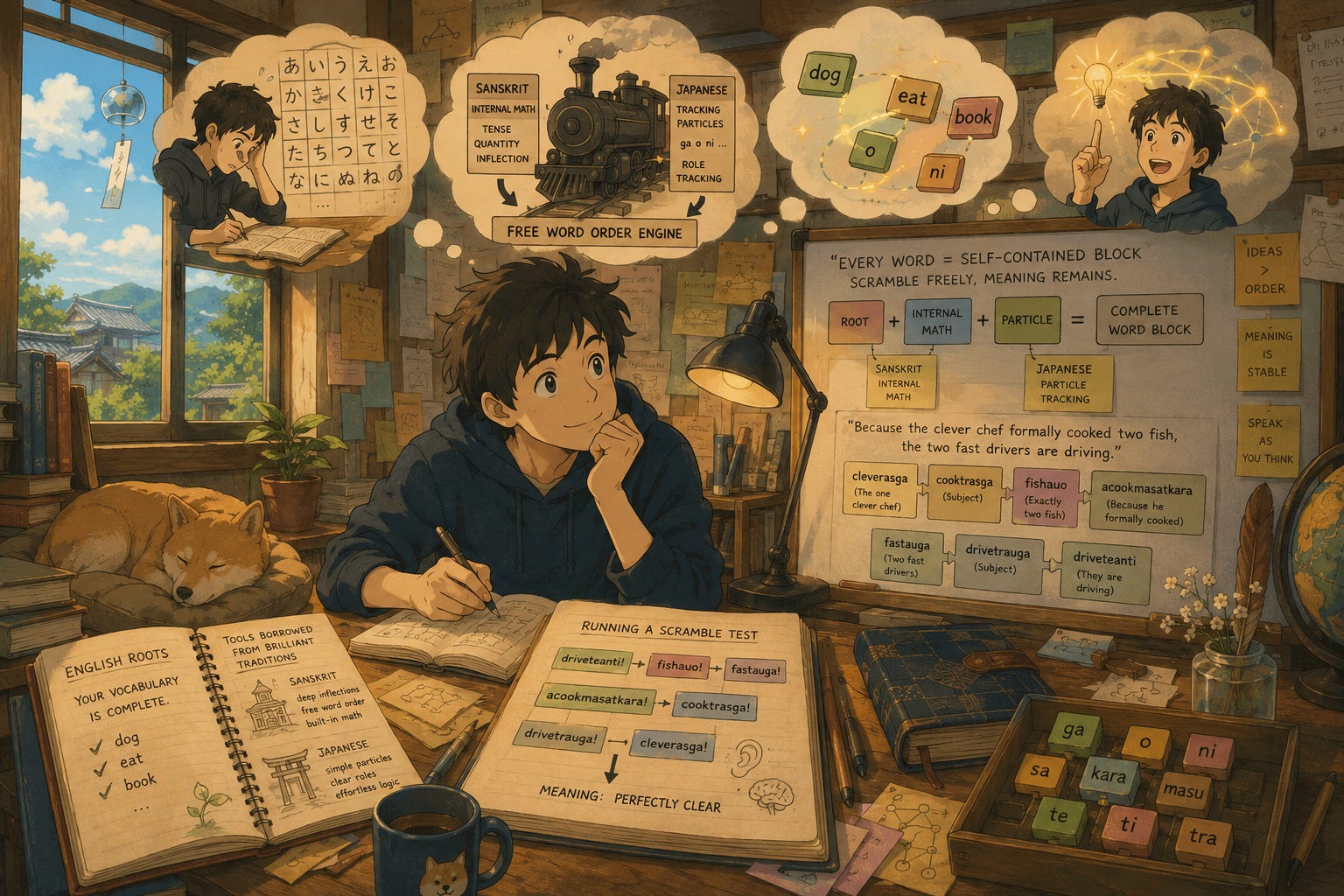
Because the metadata stays welded to the words, I can completely scramble the sequence:
Driveteanti! Fishauo! Fastauga! Acookmasatkara! Cooktrasga! Drivetrauga! cleverasga!
To an outsider, it sounds like an unhinged text glitch. But to a Janskrish listener, the meaning is completely clear. Their ears instantly read that the fish (-o) are being acted upon, the cooking is the past cause (-kara), and the fast drivers (-au-ga) are the ones driving. The sentence remains perfectly stable.
Welcome to the Workshop
At its heart, Janskrish is just a creative outlet—a fun, personal way to look at the mechanics of speech through a slightly different lens. Whether it turns out to be a useful brain exercise, a fun human-encryption joke between friends, or just a quirky design lab born from a late-night study epiphany, I’m having a little fun building it.
If you like creative experiments, language shortcuts, or just watching a quirky hobby evolve, I’d love to have you along for the ride.
Welcome to Janskrish.